Build With LLMs: From Context Engineering to Multi-Agent Systems
Modern LLM Systems & AI Applications
- Attend live online sessions led by CMU School of Computer Science faculty
- Design, evaluate, and secure reliable LLM-powered systems
- Engineer RAG, tool calling, and multi-agent AI workflows
- Build production-ready applications powered by modern LLMs
Talk to an advisor :
+1-844-532-7688
Talk to an advisor :
+1-844-532-7688- Admission closesSeptember 26, 2026
- Program Duration8 weeks
- Learning FormatLive, Online, Interactive
Key Features
CMU Credential
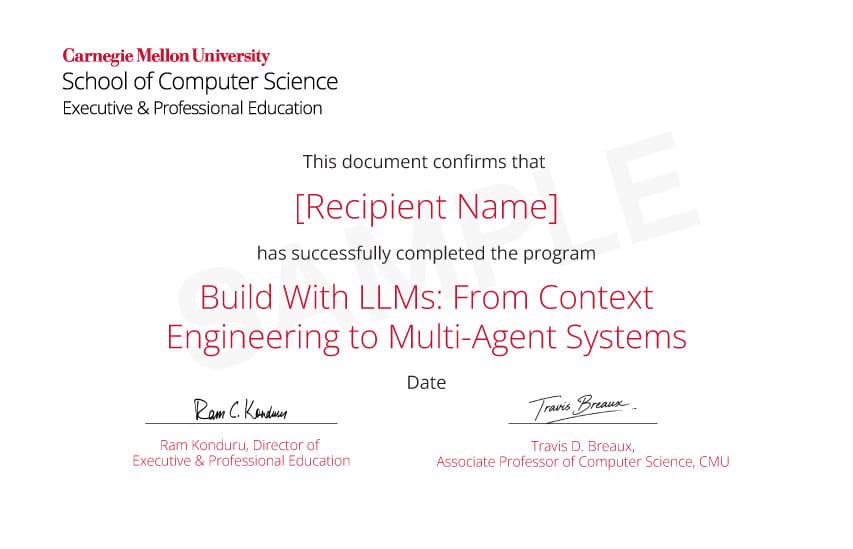
Earn a certificate of completion from CMU School of Computer Science Executive Education
Curriculum designed and delivered by CMU School of Computer Science faculty
Technical Foundations
Trace LLM evolution from word embeddings via transformers to frontier models
Explore self-attention, BERT, in-context learning, and modern training approaches
Applied LLM Engineering
Build RAG pipelines with retrieval, embeddings, chunking, and vector databases
Design tool integrations using tool calling, permissions, APIs, and MCP
Need to know more?
Need to know more?
Talk to an Advisor
Toll Free : +1-844-532-7688
Corporate Training
Enroll your employees into this program, NOW.

Talk to an Advisor
Toll Free : +1-844-532-7688
Career Opportunities
- AI / LLM Engineer
- Agentic AI Engineer
- AI Solutions Architect
AI / LLM Engineer
Builds production-ready LLM applications using context engineering, RAG pipelines, and evaluation guardrails. Develops scalable solutions that integrate LLMs with enterprise data, APIs, and workflows.
Source: Glassdoor






Essential Skills You Will Develop
- Multi Agent Systems
- AI Safety
- Chain of Thought Prompting
- Context Engineering
- Embeddings
- In Context Learning
- LLM Evaluation
- Retrieval Augmented Generation
- Vector Databases
- Model Context Protocol
- Large Language Models
- Prompt Engineering
- Tool Calling
Earn Professional Certifications
Upon successful completion, earn a digital certificate from Carnegie Mellon University School of Computer Science Executive Education - validating your expertise in building production-grade LLM and Agentic AI systems.
- #1 in Artificial Intelligence programs
- #1 in Programming Language and Systems
- #1 for overall graduate computer science programs
Program Curriculum
Take your LLM skills from foundations to building reliable AI applications. Explore context engineering, reasoning, RAG, tool integration, multi-agent systems, and AI safety while developing and evaluating real-world LLM solutions.
- Program Induction - Build With LLMsYou will be introduced to the program and learning journey through a program overview.
- Foundations of Large Language ModelsExplore the evolution of language models from embeddings to transformers, BERT, GPT, T5 and GPT-3. Understand pre-training data, corpora and data controversies. Examine benchmarks, contamination, scaling laws and emergent abilities. Explore the modern landscape of multimodal, reasoning, small, and open models, as well as MoE. Learn instruction tuning essentials, including FLAN and Self-Instruct, in a condensed format.
- In-context Learning and Reasoning - CoT to Reasoning ModelsLearn prompt engineering fundamentals through instructions, templates, demonstrations, selection and order. Explore ICL, prompt sensitivity, biases, calibration and experiment design. Cover few-shot and zero-shot CoT, triggers, self-consistency and Auto-CoT, along with CoT limits and faithfulness. Learn Self-Ask, Plan-and-Solve, Step-Back, Tree/Graph-of-Thoughts and how reasoning models (o1/R1-class) are trained, including overthinking.
- Augmentation: RAG, Tool Calling and MCPLearn RAG fundamentals including chunking, vectorization and similarity. Explore RAG limits, lost-in-the-middle and RAG vs long-context. Cover advanced chunking, embeddings and vector databases in practice. Learn tool-use foundations, tool evaluation and function calling mechanics. Explore web agents and Model Context Protocol (MCP), including architecture, servers and integrations.
- Multi-Stage Pipelines & Self-VerificationExplore task decomposition and prompt chaining with DecomP and Least-to-Most. Get an introduction to LangChain. Learn auto-prompting with APE, self-correction pitfalls and Chain-of-Verification. Understand LLM-as-a-Judge evaluation and its biases.
- Agentic AI - Agents, Memory & CollaborationExplore agent fundamentals with ReAct, Reflexion and the TAO loop. Learn about agent memory systems and frameworks such as AutoGen and AgentKit. Understand planning challenges with LLM-Modulo and TravelPlanner. Explore multi-agent collaboration, debate and Mixture-of-Agents. Examine agent failure modes and modern frameworks including LangGraph and CrewAI.
- Reliability & AlignmentUnderstand hallucinations, including types, sources, calibration and mitigation. Explore bias, toxicity, fairness metrics and detoxification. Learn about sycophancy and the RLHF/InstructGPT pipeline. Examine ethics, deception and Sleeper Agents through condensed highlights.
- LLM SecurityExplore prompt injection, including direct and indirect attacks and their mechanics. Learn about jailbreaking families, real-world attack case studies and key defenses such as guard models, firewalls and detection. Cover the OWASP LLM Top 10, data poisoning and model theft. Apply production guardrails in a hands-on NeMo/LlamaGuard implementation lab.
- AI for Software EngineeringCovers code generation evaluation and SWE agents like SWE-bench and OpenHands. Includes hands-on work with coding agents and examines the trade-off between development velocity and technical debt.
- Build with LLMs Capstone ProjectDesign and build an agentic LLM system combining RAG with MCP-based tools. Apply task decomposition, self-reflection, and orchestration; then evaluate faithfulness, tool correctness, sycophancy, and jailbreak resistance, and present your findings alongside mitigation strategies.
17+ Tools Covered

















Projects Covered
MCP Powered Order Assistant with Human Approval
Build an MCP server that connects an AI assistant to order, returns and shipping tools, with human approval, audit logging and failure handling.
.jpg "MCP Powered Order Assistant with Human Approval")
Multi Agent RFP Response System
Orchestrate three specialized agents to extract RFP requirements, draft evidence-based responses and red-team claims using LangGraph or CrewAI.

Secure an AI Copilot Through Red Teaming
Red-team an AI copilot using prompt injection, strengthen it with guardrails, and measure improvements in its resilience through before-and-after security scans.

Secure RAG Powered AI Agent
Develop a RAG agent that answers from trusted documents, then test it against prompt injection and strengthen its resilience with security guardrails.

AI Assistant for Small Business Support
Create an AI assistant grounded in SBA and IRS guidance that answers business queries and takes action through an appointment-booking tool.

AI Powered IT and HR Helpdesk
Design an internal helpdesk assistant that retrieves relevant information, answers employee queries and creates support tickets with human approval.

AI Assistant for Campus Policy Support
Develop an AI assistant grounded in CMU academic policies to provide reliable, policy-based answers and support informed decision-making.

Advanced Context Engineering for Coding Agents
Apply context engineering to help coding agents tackle complex production codebases using compaction, sub-agents, re-steering, and structured research and implementation workflows.

Context Engineering for Effective AI Agents
Explore how to manage context for AI agents through system prompts, tool selection, retrieval, compaction, and long-horizon memory to improve agent reliability.

Securing AI Agents in Production Lessons from Replit
Examine the Replit database incident and identify controls for safer AI agents, including IAM restrictions, approval gates, sandboxing, backups, monitoring, and policy-as-code.

Program Faculty

Travis D. Breaux
Associate Professor of Computer Science, Carnegie Mellon UniversityA leading researcher in AI, privacy, and software engineering, Professor Travis D. Breaux specializes in trustworthy AI, LLM-powered systems, and secure, policy-compliant software design.
Still have questions?
Our dedicated team is prepared to answer them.
Total Program Fee
$ 4,500
Pay in Installments
You can pay monthly installments using our payment partners with low APR and no hidden fees.
Program Cohorts
- Limited seats Left
CMU Build With LLMs: From Context Engineering to Multi-Agent Systems Nov 2026
05 Nov, 2026 - 11 Feb, 2027
WeekdayMTuWThFSaSu
17:00 - 18:30 CST
Induction on 28 Oct, 2026
Who Is This Program For?

- AI and ML professionals
- LLM application professionals
- Software engineers and developers
- AI systems engineers
- AI application engineers
Eligibility Criteria
- Functional knowledge of Python programming
- Familiarity with machine learning and LLM concepts
- 3+ years of work experience in IT or technology roles
How To Apply
- 1Submit Application
Submit your online application
- 2Reserve Your Seat
Pay the program fees to complete your enrollment
- 3Start Learning
Congratulations! You are now enrolled into the program
Start Application
Demand For Program
Large language models are evolving from standalone text-generation tools into systems that can reason, retrieve external knowledge, use tools, and coordinate agents. Building these systems requires engineering fluency across context engineering, in-context learning, reasoning, retrieval, tool integration, agent orchestration, and AI safety.
This program addresses that progression, from foundational LLM architectures to advanced applications. You'll explore how to guide models through context and demonstrations, apply reasoning techniques, ground outputs through RAG, connect models to external systems using MCP, and design autonomous and multi-agent workflows. The program culminates in a capstone where you'll build and evaluate an agentic LLM system against defined measures of reliability, tool correctness, sycophancy, and resistance.
Demand For Program

Program FAQs
This is a live online certificate program from CMU’s School of Computer Science Executive and Professional Education that trains technical professionals to design and deploy LLM-powered AI systems.
The curriculum spans from foundational LLM concepts through context engineering and prompting to advanced system design (RAG pipelines, tool integration, and multi-agent workflows).
About Carnegie Mellon University
At Carnegie Mellon University School of Computer Science Executive Education, we provide the skills and tools necessary to solve real-world technical problems by equipping the next generation of technology leaders with the experience, insights, and novel solutions developed by our community of computer science experts. From custom training programs to online individualized learning, our cutting-edge programming - backed by faculty who pioneered the field - takes your skill set to the next level, giving you the tools to tackle your organization’s next technological challenge.